The initial contact with EDCs happens very early in life and investigating how and in what capacity they can reach a developing baby is important for understanding the effect they have on lifelong health.
During pregnancy expectant mothers can be subjected to a multitude of EDCs via food, skin contact or through the respiratory tract. Regardless of the route into the human body these can then enter the maternal blood. For some EDCs it has been proven that they then pass from the mother to the baby via the placenta.
What is the placenta?
The placenta is a vital organ during pregnancy. It is multifunctional, enabling the transfer of nutrients, gases, waste and signalling molecules, such as hormones, between the mother and the developing baby. All of its many functions are necessary to enable proper growth and development of the baby in the womb. Importantly, the placenta also acts as the first line of defence shielding the baby from environmental chemicals and pathogens.
Although offering a robust layer of protection the placenta is not impenetrable, and EDCs have been detected in amniotic fluid and the umbilical cord blood.
From there they can enter into the baby’s circulation and reach its organs as they develop. In addition to effects on the baby from direct exposure, EDCs can also have an impact on placental growth and function which can then influence development or cause pregnancy complications.
One of the aims of this study is to mimic the interface of fetal-placental transport. If chemicals are added on the placental side, which ones and how much of each is transferred across the barrier to the baby?
What effect do these chemicals have on the growth and normal function of the cells? Do they cause changes in the expression of genes?
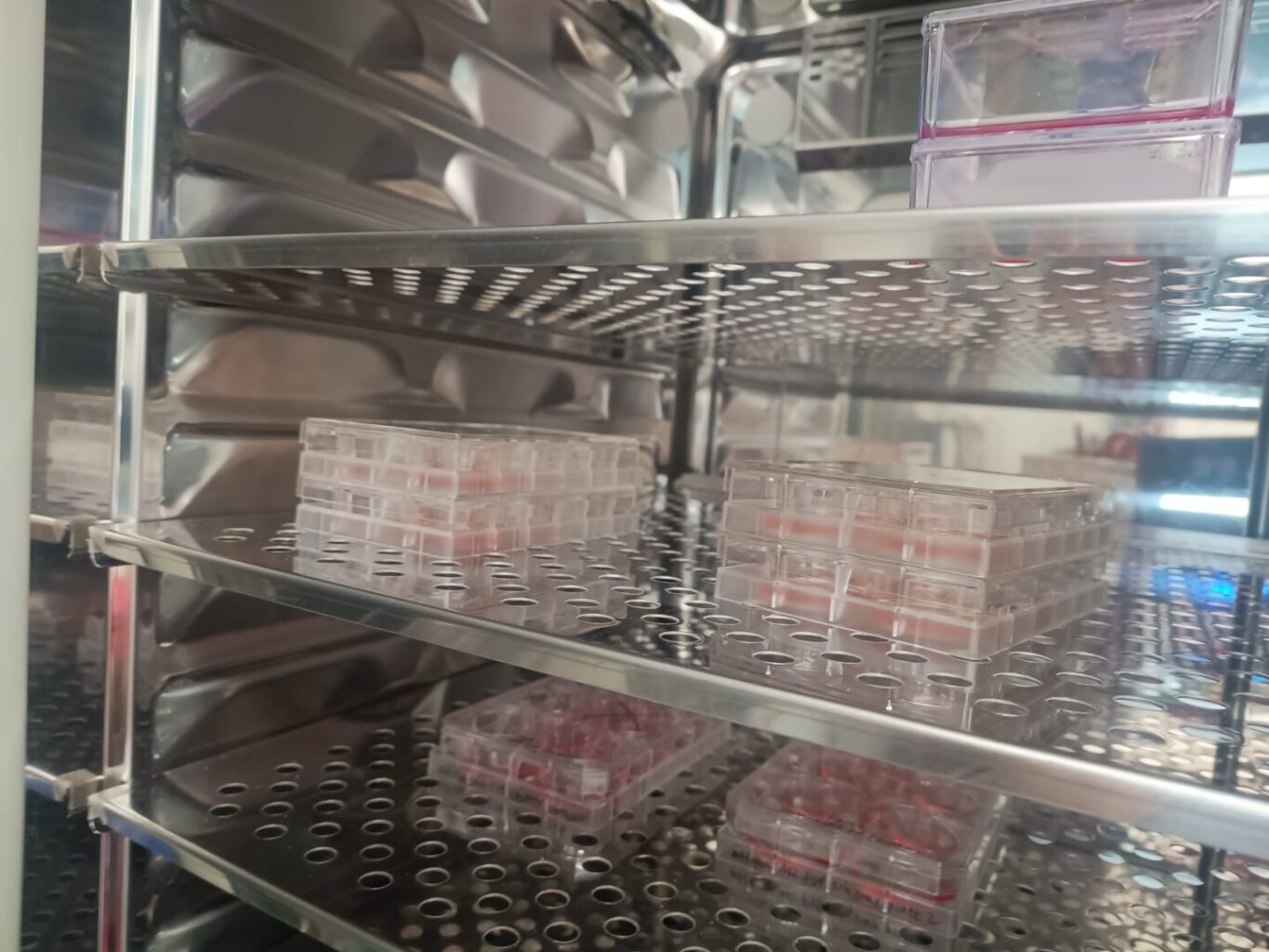
Trophoblast cells growing in our incubator.
Modelling the placenta in a dish
The placenta is formed from a very special type of cells that are found no-where else in the body – known as trophoblasts. Trophoblasts cells form in the very earliest days of pregnancy, and they are the cells that interact with the lining of the womb to first anchor the developing embryo to the mother’s body, and then direct her blood towards the growing baby.
Later in pregnancy, trophoblasts form structures called villi, which have a high surface area in contact with the mother’s blood, enabling exchange of nutrients and gases. A unique property of trophoblast cells is that they can fuse together to make a big sheet with no gaps in between. This provides an excellent barrier, protecting the baby from unwanted substances in the mother’s blood.
We are growing trophoblast cells in our laboratory, and using them to investigate whether EDCs can cross the placenta by mimicking other molecules that the placenta takes up.
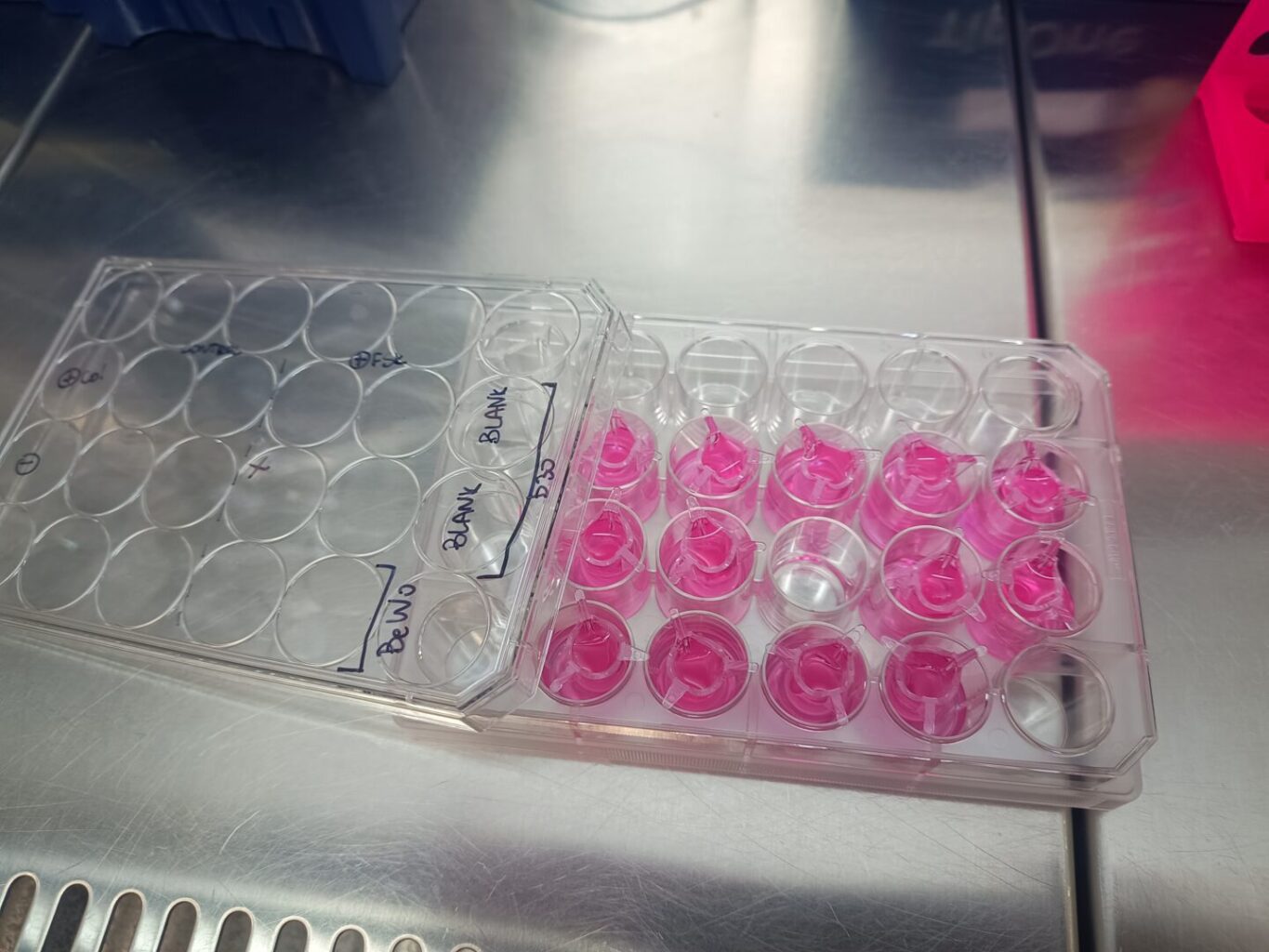
Trophoblast cells growing on membrane inserts to mimic the placental barrier.
We are also investigating how exposure to EDC mixtures affects the growth, fusion and health of the trophoblast cells themselves. To do this we grow the trophoblast cells in a dish on a special membrane and matrix of proteins that resemble their natural environment, bathed in a solution containing factors that allow them to grow. We can add factors in their growth solution to encourage the cells to fuse together.
In our experiments we test how adding EDCs will interfere with the rate of growth, and if they prevent cells from fusing. We can also record whether the trophoblast forms a complete barrier that would protect the embryo, or if there are holes in this barrier.
So far, we have found that very high doses of EDCs prevent the cells from growing and forming a barrier. We are currently testing mixtures of EDCs at doses that people would be exposed to, to understand if there is any impact on trophoblast function.