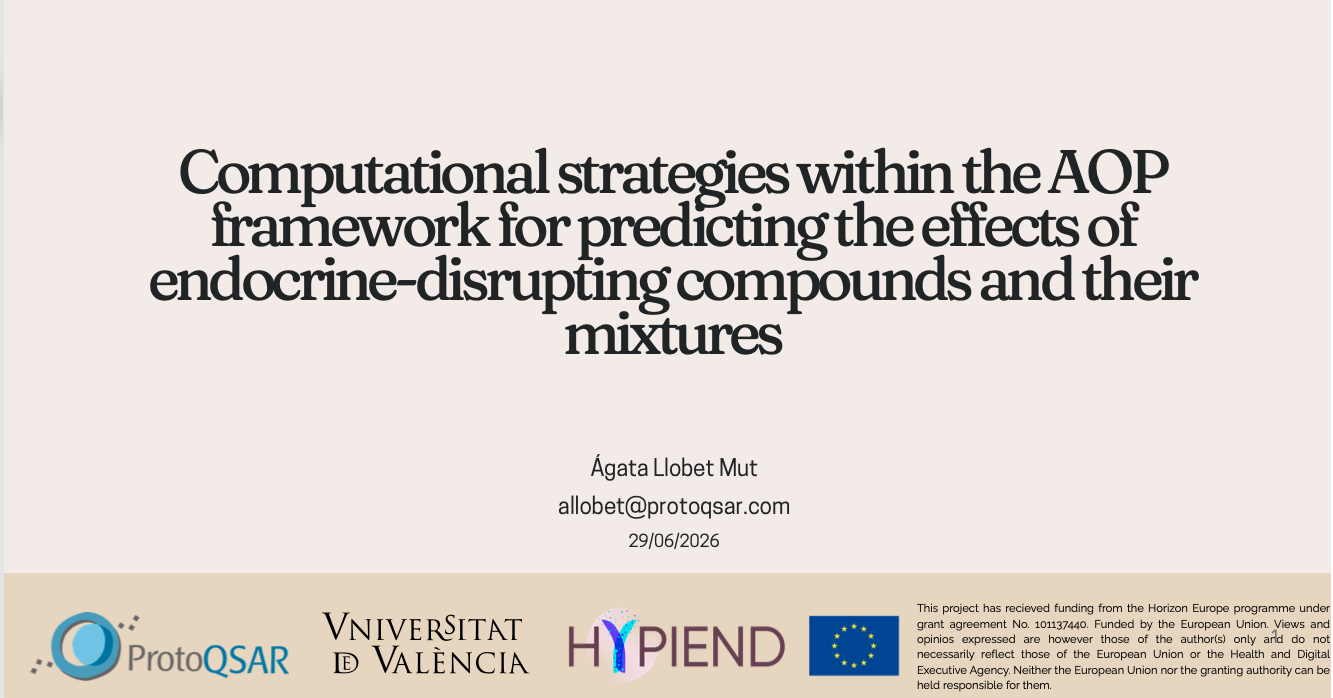
HYPIEND research was presented at the ESPA Workshop, held in Salamanca, Spain, on 29 June 2026. Ágata Llobet-Mut from ProtoQSAR delivered the presentation “Computational strategies within the AOP framework for predicting the effects of endocrine-disrupting compounds and their mixtures.”
The work addresses one of the major challenges in endocrine disruptor research: understanding the potential health effects of real-life exposure to complex chemical mixtures, rather than considering individual compounds in isolation.
To tackle this challenge, the research uses Adverse Outcome Pathways (AOPs), which provide a mechanistic framework for linking an initial interaction between a chemical and a biological target to subsequent biological changes and, ultimately, an adverse health outcome.
The research presented at the workshop focuses on three complementary areas: the construction of consensus AOPs and AOP networks related to endocrine disruption, the development of chemoinformatic models to predict the effects of EDCs and their mixtures, and the study of ligand–receptor interactions to better characterise agonist and antagonist mechanisms of action.
To achieve this, the approach combines SAR and QSAR models developed according to OECD guidelines, computational methods for predicting mixture effects, and molecular modelling techniques including molecular docking and molecular dynamics simulations. The presentation also showed how QSAR models are being explored across several endocrine-related receptors, including estrogen, androgen, thyroid, thyrotropin and glucocorticoid receptors.
By integrating these different computational approaches within the AOP framework, the research aims to contribute to the development of robust in silico tools for endocrine disruptor risk assessment, supporting more efficient, mechanistically informed and regulatory-relevant strategies for human health protection.