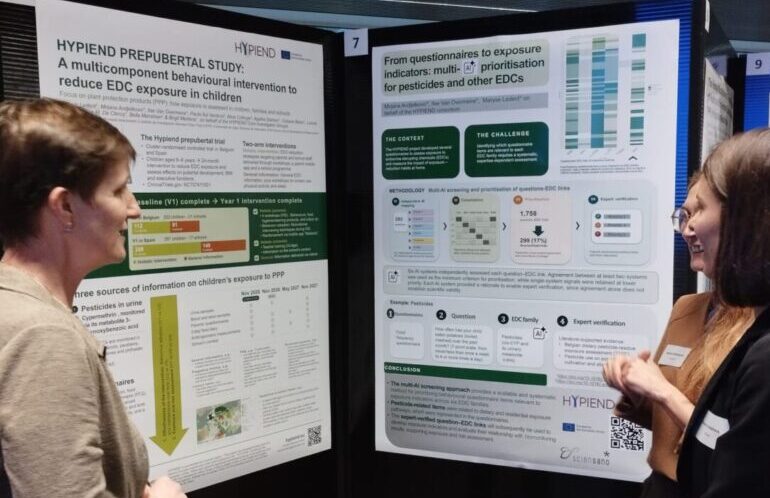
Two scientific posters highlighted AI-supported exposure assessment and strategies to reduce children’s exposure to endocrine-disrupting chemicals.
HYPIEND researchers Mirjana Andjelkovic and Maryse Ledent, from Sciensano, presented two scientific posters at the symposium Chronic Human Health Effects of Plant Protection Products: From Evidence to Action, held on 23 October 2026 in Brussels, Belgium. The event brought together 120 participants to discuss the long-term health effects of pesticide exposure and advances in exposure and risk assessment.
As part of the poster session, HYPIEND contributed two studies addressing complementary aspects of exposure to endocrine-disrupting chemicals (EDCs), including pesticides.
Reducing children’s exposure to endocrine disruptors
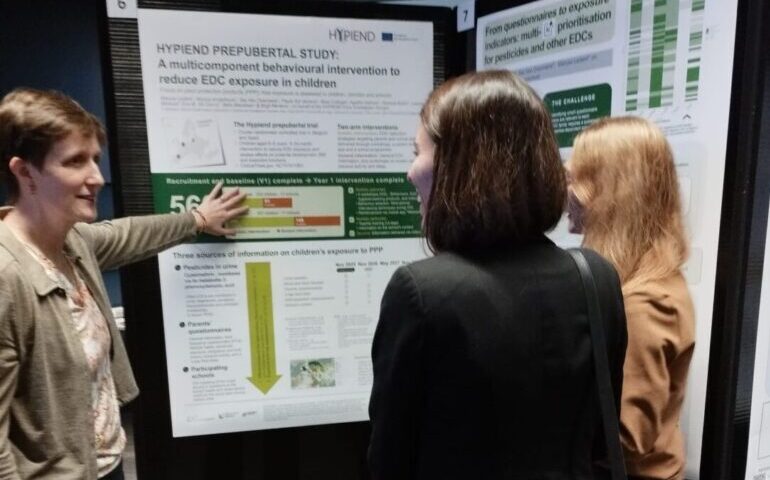
The second poster, “HYPIEND prepubertal study: A multicomponent behavioural intervention to reduce EDC exposure in children“, presented the progress of HYPIEND’s intervention involving 560 children aged 6–8 years from 38 schools in Belgium and Spain.
The study evaluates whether a 24-month behavioural intervention involving families and schools can reduce children’s exposure to EDCs and improve health-related outcomes.
The intervention combines educational workshops, behavioural support, digital tools and school-based activities. Exposure to pesticides and other chemicals is assessed through biological samples, parental questionnaires and information about children’s home and school environments.
With recruitment, baseline assessments and the first year of intervention completed, the study is progressing towards evaluating the effectiveness of these strategies in reducing exposure during a sensitive stage of child development.
Using AI to improve exposure and risk assessment
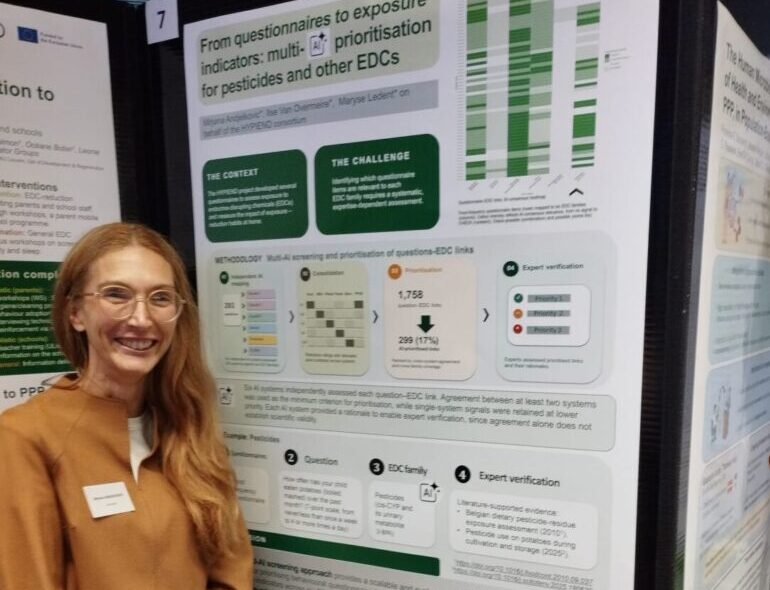
The first poster, “From questionnaires to exposure indicators: multi-AI prioritisation for pesticides and other EDCs“, by Mirjana Andjelkovic, Ilse Van Overmeire and Maryse Ledent, presented an innovative approach to identifying questionnaire items relevant to chemical exposure.
The research used six independent AI systems to evaluate the relevance of 293 questions against six families of endocrine-disrupting chemicals, generating 1,758 potential links. Of these, 299 (17%) were prioritised for expert review based on agreement between at least two AI systems.
This approach aims to support the development of exposure indicators that can be compared with human biomonitoring data, improving the assessment of exposure to pesticides and other EDCs while maintaining scientific expert oversight.
The symposium, jointly organised by the Belgian Federal Public Service Health, Food Chain Safety and Environment (FPS HFCSE), Sciensano and the Federal Agency for the Safety of the Food Chain (FASFC), gathered researchers, public health experts and regulatory authorities to exchange scientific knowledge and explore ways to improve the assessment of chronic health risks associated with plant protection products (PPPs).